Product costs, availability and item numbers may vary online or by market.
Snow Blower Maintenance
Before performing maintenance, cleaning, repairs or inspection on a snow blower, disengage all control levers, stop the engine and wait for the moving parts to stop completely. If your model has a key, remove it. On a gasoline-powered model, disconnect the spark plug ignition wire, grounding it against the engine. Disconnect an electric model from the power source. Follow any pre-maintenance instructions the manufacturer specifies, including those for the use of protective gear while performing the work.
Maintenance may differ, depending on your snow blower model. Read your documentation before beginning any work and always follow the manufacturer’s instructions for use, maintenance and tips on safety. Here are some common procedures:
⦁ Check shear bolts/pins (if equipped) and other fasteners frequently for proper tightness.
⦁ Check skid shoes/plates (if equipped) and shave plates/scraper bars for wear and damage; adjust or replace as needed.
⦁ Check the scraper bar/shave plate (if equipped) and replace as needed.
⦁ Verify that the unit’s control levers engage and disengage correctly and adjust them as needed.
⦁ Maintain the proper tire pressure.
⦁ Lubricate the machine according to the manufacturer’s instructions.
⦁ After use, run the snow blower for a few moments to clear out snow and to prevent freeze-up of the auger or impeller.
⦁ Sweep off the machine and dry it with a cloth to help keep melting snow and ice from causing corrosion or rust.
Gas snow blower maintenance requires some additional attention:
⦁ Check the oil level before each use and add as needed.
⦁ Change the spark plug every 100 hours or once a season.
⦁ Change the air filter as needed.
Cordless snow blower maintenance requires some specific procedures as well:
⦁ Charge the batteries fully before using the snow blower.
⦁ If you have an uninsulated garage, store and charge the snowblower batteries inside your home.
⦁ The manufacturer may recommend not storing the battery fully charged or may recommend charging the battery occasionally over long storage periods.
Some manufacturers specify running a gas snow blower until the fuel tank is empty before performing certain maintenance procedures. Follow the instructions for your specific model.
Store a Snow Blower After the Snow Season
Store your snow blower in an area that’s dry, clean and away from corrosive materials. Follow the storage procedure outlined by the manufacturer. Here are some common practices:
⦁ Allow the machine to cool before you store it.
⦁ Clean the exterior of the machine and the engine and let them dry before putting the snow blower away for the season.
⦁ If you have a gasoline-powered snow blower, prepare the fuel system for storage. Manufacturers may specify running the snow blower until the fuel tank, fuel lines and carburetor are empty. Using fuel mixed with a fuel stabilizer may also be an alternative. Follow the instructions for your specific snow blower and engine.
⦁ If storing a snow blower with fuel in the fuel tank, make sure it’s in an area where fumes will not come into contact with a spark or flame.
⦁ Lubricate the snow blower as instructed by the manufacturer’s documentation.
⦁ If storing the machine in an unventilated area, use a light oil or silicone to rust-proof the snow blower.
For cordless snow blowers, the manufacturer may recommend periodic charging of the battery.
Do not run a gasoline-powered snow blower indoors or in an area that does not have proper ventilation.
Store a Snow Blower After the Snow Season
Store your snow blower in an area that’s dry, clean and away from corrosive materials. Follow the storage procedure outlined by the manufacturer. Here are some common practices:
⦁ Allow the machine to cool before you store it.
⦁ Clean the exterior of the machine and the engine and let them dry before putting the snow blower away for the season.
⦁ If you have a gasoline-powered snow blower, prepare the fuel system for storage. Manufacturers may specify running the snow blower until the fuel tank, fuel lines and carburetor are empty. Using fuel mixed with a fuel stabilizer may also be an alternative. Follow the instructions for your specific snow blower and engine.
⦁ If storing a snow blower with fuel in the fuel tank, make sure it’s in an area where fumes will not come into contact with a spark or flame.
⦁ Lubricate the snow blower as instructed by the manufacturer’s documentation.
⦁ If storing the machine in an unventilated area, use a light oil or silicone to rust-proof the snow blower.
For cordless snow blowers, the manufacturer may recommend periodic charging of the battery.
Do not run a gasoline-powered snow blower indoors or in an area that does not have proper ventilation.
Clear a Clogged Discharge Chute
Never clear the discharge chute with your hands. Hand contact with rotating discharge impeller blades is the most common cause of snow-blower-related injuries. To clear a clogged discharge chute, follow the instructions below.
Instructions
Step 1: Turn Off the Snow Blower
Turn off the snow blower and wait 10 seconds. Ensure the impeller blades are no longer rotating.
Don’t attempt to clear out a clogged chute while the snow blower is running.
Step 3: Clear the Discharge Chute
Adjust the Snow Blower Skid Shoes/Plates
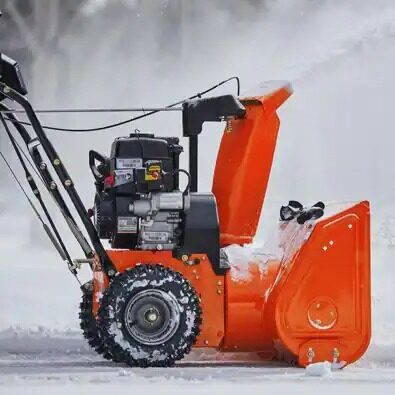
Most two-stage snow blowers, three-stage snow blowers and some single-stage snow blowers have skid shoes or plates. Adjusting the skid shoes/plates on a snow blower allows you to control how close to the ground the unit will clear snow.
Your manual should include specific instructions for adjustment on different surfaces. Follow these instructions for proper adjustment and be sure to follow the pre-maintenance procedures described above. In general, if you’re clearing an even, paved surface, you can adjust the skid shoes to a higher position, setting the scraper bar/shave plate to less clearance. If you’re clearing an unusually irregular surface, adjust the skid shoes to their lowest position, giving the scraper bar/shave plate maximum clearance.
Snow Blower Repair and Troubleshooting
Most snow blower repairs need to be handled by an authorized service provider, but there are some troubleshooting steps you can try if your snow blower isn’t functioning correctly. Check your manual for specific steps, but below are some common problems and solutions you can try. Follow the pre-maintenance steps specified by your manual before beginning work.
Problem: The Snow Blower Doesn’t Start
For cordless snow blowers, check the battery indicator lights to see if the battery is overheated. Allow it to cool down as necessary.
For gas snow blowers, be sure you’ve primed the engine. Check the spark plug and clean or replace it if needed.
Problem: The Engine Stops After Running Momentarily (Gas Models)
Slowly and carefully loosen the fuel cap to release any built-up fumes and try starting again.
Problem: The Engine Doesn’t Run Smoothly (Gas Models)
Check the spark plug and clean or replace it as needed. Also check the fuel cap for damage and the fuel cap vent for a blockage. Replace or adjust the cap as needed.
Problem: The Snow Blower Runs, but the Auger or Paddles Don’t Turn
Check the auger drive belt for wear or damage. If you find either, replace the belt.
Problem: The Snow Blower Leaves a Layer of Snow After Clearing an Area
Check the scraper bar or shave plate for wear or damage. Replace it as needed.
Problem: The Snow Blower Doesn’t Discharge Snow Correctly
Check for a clog in the discharge chute. Clear any accumulated snow with a clean-out tool. Never use your hands to clear a clog. Inspect the shear bolts or pins to see if they’re broken and check the drive belt for wear or damage. Replace any worn or damaged parts as needed.